Clients are not the only ones who act as if outside lawyers are inefficient. Individual outside lawyers censor themselves for inefficiency. Their firms then cut their time for perceived inefficiency before sending it to the client. The clients cut their time even further. Everyone seems to agree there is considerable waste that must be excised from the bill.

The existing economics of law are such that it is easy to reconcile improved quality and lower costs for clients with better realizations and higher profits for law firms. Five years ago, I did not know this. I thought we were playing a zero sum game. Nor would I have cared if anyone had told me. As detailed in previous posts, I’ve evolved in my thinking about coprosperity. This change in perspective means I have to work at trying to understand what makes for a prosperous law firm. In helping me appreciate how realizations and profit differ from raw revenue, I have to thank Toby and our mutual friend Vince Cordo of Shell. Please do not blame them, however, for the simple-minded drivel that follows.

Understandably, we lack hard data on time that lawyers decide not to record (let alone how this practice may have changed over time). But my anecdata (frequently, a lawyer who performed poorly in Basic Technology Benchmarking would inform me that I need not worry because they cut their own time) lines up with the few bits of empirical speculation I can find. These surveys suggest that 33% of worked time is not billed. The primary culprit is identified as administrative tasks but another factor is individual lawyers deciding “to purposely ‘discount’ the actual number of hours worked in order to keep clients happy.” Similarly, back when firms reported such things to NALP, the average associate at DLA Piper, for example, worked 2,462 hours to bill 1,831 hours (74% of worked time was billed). To use round numbers then, let’s assume for discussion that an exemplar lawyer works 2,500 hours and bills 75% of it (1875 hours). Let’s further assume (I’ve got no statistics on this) that a minority—say 20%—of the unbilled hours are due to self-censorship.

Lawyer Janes works 2,500 hours of which 2,000 are eligible to be billed. She bills 1875 hours.

The 1875 hours is what the firm sees. But 1875 hours is not what the firm sends to its clients. We have good data that billed realizations—the percentage of the 1875 hours billed to clients—have dropped from 93.5% to 86.7% in the last decade. But the data does not tell us how much of the recorded-hours-not-billed-to-clients are due to writedowns versus pre-negotiated discounts. The concept of standard rate, on which realization figures are based, is a maddeningly vague, used differently in different reports, and often reliant on self-reporting (Toby will have to explain). Because I can find it with Google, I will just accept previous findings that pre-negotiated discounts account for about half of the spread (this, admittedly, remains a crude exercise) between time recorded and time billed. Thus:

In 2004, Lawyer Janes works 2,500 hours of which 2,000 are eligible to be billed. She bills 1875 hours. The firm has already negotiated discounts that bring her total down to 1813 standard hours. In addition, the firm writes down her time to 1753 hours actually billed to clients.

In 2014, Lawyer Janes works 2,500 hours of which 2,000 are eligible to be billed. She bills 1875 hours. The firm has already negotiated discounts that bring her total down to 1746 standard hours. In addition, the firm writes down her time to 1625 hours actually billed to clients.

That is not the end of the story. Clients have grown much more aggressive in cutting legal invoices since the Great Recession. Or so the story goes. The story is true. Comparing collected realization pre- and post-Recession, clients increased the average amount they cut from bills by 500%. That’s a big jump. But this framing obscures the low baseline. In 2004, the average client was paying 99.1% of their billed invoices. In 2014, the average client is still paying 95.7% of their billed invoices. So:  

In 2004, Lawyer Janes works 2,500 hours of which 2,000 are eligible to be billed. She bills 1875 hours. The firm had already negotiated discounts that bring her total down to 1813 standard hours. In addition, the firm writes down her time to 1753 hours actually billed to clients. The firm collects 1738 hours.

In 2014, Lawyer Janes works 2,500 hours of which 2,000 are eligible to be billed. She bills 1875 hours. The firm had already negotiated discounts that bring her total down to 1746 standard hours. In addition, the firm writes down her time to 1625 hours actually billed to clients. The firm collects 1555 hours.

I’ll go Excel on the 2014 numbers and add a $400/hr billable rate with some additional crude data on the cost of an associate. And we’ll spread the billed work evenly among 4 clients.
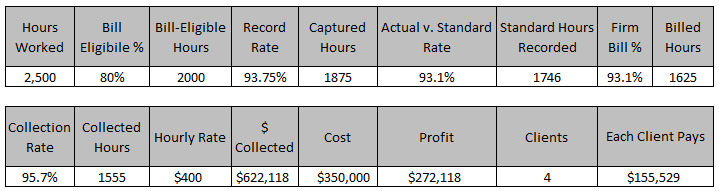
Now, let us imagine an alternative scenario where some initiative (e.g., a Service Delivery Review) leads both to (i) actual improved integration of process and technology into the workflow producing modest BFC (Better, Faster, Cheaper) results and (ii) a structured dialogue between the client and law firm that convinces both sides there is less waste in the delivery of legal services. In this hypothetical, the law firm lawyers, who are closest to the improvements, are more convinced of the gains than their clients. Because of the increased efficiency, the law firm can serve more clients in fewer hours. 
 
These are modest gains. Yet, the client is spending 15% less, and the law firm is profiting 16% more, while the individual lawyer spends 50 less hours in the office (an hour per week or a real vacation). The foregoing exercise also drives home one of Toby’s favorite points: discounts and writedowns come entirely at the expense of profits. What may only be a small percentage of raw revenue can be a substantial percentage of total profit. The margins are where the magic happens.

The above assumes that the law firm has picked up a new client. It is nice to believe that improvements in quality paired with reductions in cost would result in additional work and new clients. But even if the total work is finite, the law firms can still increase profits without charging their clients more. This, however, means fewer lawyers. While subsisting with fewer lawyers may sound like a post-apocalyptic hellscape straight out of Mad Max (water, gas, bullets, and lawyers all in scare supply), it is the world in which we have lived for the last half-dozen years. Using the preceding scenarios, compare how many lawyers are required to collect on 200,000 hours of time and the attendant impact on profits:

The gains can still be shared. The finite client base can spend appreciably less (i.e., save money) on legal services while the law firm profits more:

The foregoing is an admittedly crude explanation of why we are not necessarily playing a zero-sum game, even in an environment still dominated by the billable hour. Client cost reductions need not come out of law firm profits. Increased law firm profits need not come at the expense of clients. Structured dialogue between the two can result in Better, Faster, Cheaper benefiting both parties. 

++++++++++++++++++++++++++++
Casey Flaherty is the founder of Procertas. He is a lawyer, consultant, writer, and speaker focused on achieving the right legal outcomes with the right people doing the right work the right way at the right price. Casey created the Service Delivery Review (f.k.a., the Legal Tech Audit), a strategic-sourcing tool that drives deeper supplier relationships by facilitating structured dialogue between law firms and clients. There is more than enough slack in the legal market for clients to get higher quality work at lower cost while law firms increase profits via improved realizations.
The premise of the Service Delivery Review is that with people and pricing in place, rigorous collaboration on process offers the real levers to drive continuous improvement. Proper collaboration means involving nontraditional stakeholders. A prime example is addressing the need for more training on existing technology. One obstacle is that traditional technology training methods are terribleCompetence-based assessments paired with synchronous, active learning offer a better path forward. Following these principles, Casey created the Legal Technology Assessment platform to reduce total training time, enhance training effectiveness, and deliver benchmarked results.
Connect with Casey on LinkedIn or follow him Twitter (@DCaseyF).

If you follow the automotive industry (I was in-house counsel at a car company), you follow Toyota (usually the top selling automaker in the world). If you study process improvement (I am a Lean Six Sigma Black Belt), you study Toyota (the Toyota Production System is the precursor of Lean). If you are interested in sourcing (like Toby, I wrote a chapter in the Legal Procurement Handbook), you are interested in Toyota (posterchild for deep supplier relationships). I do not pretend to be an expert on The Toyota Way. But I have been convinced that a strong-arm approach to strategic supplier relationships is a sub-optimal strategy over the long term.

I already told the story of how experience with stellar outside counsel changed my outlook on the inside/outside counsel relationship. But the most influential narrative in the evolution of my scholastic understanding of supplier relationships comes from automotive industry after the SUV bubble popped in the late 90’s.

For the first time, the Big 3 experienced the Japanese automakers as an existential threat. In studying their competition, the Big 3 found that the supply base was a substantial source of the Japanese cost advantage. The Big 3 sought to mitigate this advantage by leaning on their own suppliers for cost reductions, which they got—just not enough. The Big 3 also had to deal with the fallout from the rapid transformation of their supplier relationships. This fallout included inferior quality parts and a depleted, antagonized supply base, many of whom went bankrupt in the Great Recession.

The Big 3’s cost savings were insufficient because the Japanese automakers responded with cost reduction targets of their own. In addition to lower costs, the Japanese also mandated quality improvements. The Japanese automakers achieved both reduced cost and improved quality while emerging with an engaged, profitable supply base, which included many American suppliers. The distinguishing feature in the Japanese approach is that the Japanese assisted their suppliers in hitting their targets.

Consulting teams were dispatched to strategically important suppliers with the sole purpose of helping the suppliers achieve the twin mandates of cost reduction and quality improvement. The effort was not only about developing better processes at the suppliers but also better integration of the suppliers into the overall economic value chain. The objective was more than just better performing suppliers, it was deeper supplier relationships, which are founded on a commitment to coprosperity.

It is hard to imagine a well-regarded law firm run by smart lawyers going bankrupt (well, not that hard to imagine). And not even I am arrogant enough to entertain the notion of inside counsel telling outside counsel how to run a law firm (which has always struck me as akin to herding drunken cats). But I have first-hand experience with how structured dialogue, clear expectations, and collaboration can benefit both sides of the relationship. Law firms can do better. So can clients. It is much easier to pursue better together.

In my next post, I will discuss how, even in an environment still dominated by the billable hour, improved quality and reduced costs for clients can result in higher realizations and profits for law firms.

++++++++++++++++++++++++++++
Casey Flaherty is the founder of Procertas. He is a lawyer, consultant, writer, and speaker focused on achieving the right legal outcomes with the right people doing the right work the right way at the right price. Casey created the Service Delivery Review (f.k.a., the Legal Tech Audit), a strategic-sourcing tool that drives deeper supplier relationships by facilitating structured dialogue between law firms and clients. There is more than enough slack in the legal market for clients to get higher quality work at lower cost while law firms increase profits via improved realizations.
The premise of the Service Delivery Review is that with people and pricing in place, rigorous collaboration on process offers the real levers to drive continuous improvement. Proper collaboration means involving nontraditional stakeholders. A prime example is addressing the need for more training on existing technology. One obstacle is that traditional technology training methods are terribleCompetence-based assessments paired with synchronous, active learning offer a better path forward. Following these principles, Casey created the Legal Technology Assessment platform to reduce total training time, enhance training effectiveness, and deliver benchmarked results.
Connect with Casey on LinkedIn or follow him Twitter (@DCaseyF).

In the last two weeks, the MLB’s Toronto Blue Jays have made trades and acquisitions from all over the U.S.  The team is on fire, the Rogers Centre is selling to its 45,000 person capacity and there is a winning energy in the air.  But the Blue Jays,  their fans, and their latest string of new players are not the only ones who are noticing this great city.  Yesterday, Littler Mendleson, the Bay Area Headquartered AmLaw 100 Labour and Employment boutique opened its doors in Toronto and Canada.  Aside from the new spellings it will need to adopt, the opening signals what I have always held true.  Toronto is a world class city, with opportunity for the legal market that expands beyond the “6”.  I could be lamenting the consolidation of the industry and pain of the current exchange rate or the price of oil, but today, I am (possibly naively), buoyed by the energy of the announcement and the paradigm shift it represents for this legal market.  All eyes are on Toronto and thankfully this time, it’s not because of our drama generating former mayor but because of the vitality of the city and the country.  There is no doubt that the legal industry is changing, if you only ever read 3 Geeks, you’ll get a pretty good sense of the angst and possibility of the current climate, and moves like this one, remind me that not all change is bad and in fact change is the necessary evil that forces us to grow and evolve.  So, as the Canadian “Geek”, let me welcome you to Toronto.  May you enjoy the city and its energy as much as I do and Go Jays Go!

I’ve been labeled a Legal Rebel, an Innovator, and a “humorless moron.” The last one I understand. But the first two have always struck me as a slightly silly. I feel like what I am best known for—the suggestion that legal professionals should get slightly better at using the machines they’ve been staring at eight to eighteen hours a day for the last twenty years—borders on banal. I took a while to realize that the innovation was not in the call for increased proficiency but in the approach.

Instead of throwing work over the wall and then reactively complaining months later about inefficiency while reviewing information-poor invoices, I tore down the wall to proactively address root causes. I defined the problem. Measured it. Analyzed it. Then I sought to improve on the status quo and maintain control of the improvements. One would think some form of this methodology would had have been in use for the past 60 years, at least. Unfortunately, in the legal market, any disciplined approach to process improvement is somewhere between innovative and revolutionary.

What was once the Legal Tech Audit is now the Service Delivery Review (“SDR”) because (a) the word “audit” makes people uncomfortable, (b) the audit concept is too one-sided, and (c) a comprehensive vendor management program has become confused (my own fault) with its most well-known component, Basic Technology Benchmarking. While the lack of basic technology training garnered the headlines, it is only one out of ten categories in the SDR. The categories are:

  • Hardware/Software
  • Mobility
  • Training
  • Staffing
  • E-Signatures
  • Document Assembly
  • Process/Project Management
  • Knowledge Management
  • Data/Analytics
  • Billing Hygiene 

Each category is supplemented by an onsite review. I will discuss each category and the onsite review in subsequent posts.

The conceptual foundation of the SDR is this: with people and pricing in place, process offers the most levers to drive continuous improvement. When deployed correctly, the SDR serves as far more than just a finger-wagging exercise. 

The SDR is the initial step in an ongoing structured dialogue. As inside counsel, it was my responsibility to set priorities and communicate clear, achievable expectations for my outside counsel, rather than just complain in vague terms about inefficiency. It was also important for me to listen and understand how my internal team and I could assist outside counsel in achieving their objectives.

To take one example, my first SDR was of a firm that preceded my tenure in-house and, no matter what happened, was going to be there long after I left. They were the quintessential sacred cow. And for good reason. They turned out to be some of the finest lawyers (and people) I’ve ever had the pleasure to know. Not only were they true substantive experts in a rather niche area, but their institutional knowledge of our mutual client was also unparalleled. While I do not think incumbency should be unassailable, it does confer legitimate advantages, which this firm had earned.

But to say that they were the very best at what they did is not to say they were perfect (no one is, author included). To their eternal credit, this group of domain experts was genuinely interested in improving the more generic aspects of their legal service delivery. They greeted the SDR with open minds (despite being professional issue spotters). When the SDR was complete, the relationship partners and I had a frank dialogue about what the findings meant and the concrete steps that should be taken as a result. They committed to a number of process improvements, which they delivered. These included better associate training on basic technology. But that was only one aspect of the review and one area in which they measurably improved.

It is worth noting, however, that, beyond their substantive expertise, these long-time incumbents also had the best knowledge management practices I ever reviewed. While, like every other firm, they got dinged where they performed below expectations, the SDR also resulted in them earning substantial goodwill in the many areas where they excelled. Combined with their commitment to, and subsequent delivery of, process improvements, the end result of the SDR was a deeper, more collaborative relationship.

Collaboration runs both ways. I, for example, needed to get more disciplined about putting new matters into the system earlier (most matters were initiated with an email, and the matter management system was updated later) in order to facilitate better accrual practices and quicker turnaround of invoices. We also developed a secure file sharing protocol that meant they had ready access to the regular reports, rather than waiting for my paralegal or me to respond to an email request. This firm was a critical piece of our workflow and better integration benefited both parties.

In short, without yet knowing the term, I had adopted a strategic sourcing perspective on supplier relationships:

All this was a bit of a surprise to me. I moved in-house with the attitude that many of the problems with the legal market are result of inside counsel being too soft on outside counsel. I still think that is true to a certain extent. But, as I will detail in my next post, there are different approaches to taking a firm line with long-term suppliers. My initial impulse to rely solely on strong-arm tactics was misguided. I owe a debt of gratitude to the law firm partners who showed me a better way. Commitments to collaboration and coprosperity were important evolutions in my thinking about the relationship between inside and outside counsel.

++++++++++++++++++++++++++++
Casey Flaherty is the founder of Procertas. He is a lawyer, consultant, writer, and speaker focused on achieving the right legal outcomes with the right people doing the right work the right way at the right price. Casey created the Service Delivery Review (f.k.a., the Legal Tech Audit), a strategic-sourcing tool that drives deeper supplier relationships by facilitating structured dialogue between law firms and clients. There is more than enough slack in the legal market for clients to get higher quality work at lower cost while law firms increase profits via improved realizations.
The premise of the Service Delivery Review is that with people and pricing in place, rigorous collaboration on process offers the real levers to drive continuous improvement. Proper collaboration means involving nontraditional stakeholders. A prime example is addressing the need for more training on existing technology. One obstacle is that traditional technology training methods are terribleCompetence-based assessments paired with synchronous, active learning offer a better path forward. Following these principles, Casey created the Legal Technology Assessment platform to reduce total training time, enhance training effectiveness, and deliver benchmarked results.
Connect with Casey on LinkedIn or follow him Twitter (@DCaseyF).
Regardless of whether you love this concept, or hate it, the University of Michigan’s Medical School may have just laid out the future of the Librarian as “Informationist.”

In its announcement regarding the opening of the new A. Alfred Taubman Health Sciences Library (THSL), U-M Med School removed all of the books, and bookshelves, and created a 137,000 square foot “natural light-filled medical education hub that supports in-person, collaborative, active learning.”

Books are off-site and available via “rapid delivery upon request.”

The Library is staffed by “Informationists” that serve the University and general public to access the “stored knowledge of medical and health science.”

Space is for learning, training, teaching, connecting, simulation, and collaboration. Not simply for housing “stored knowledge.”

I, for one, like this concept. I like the idea of having Informationists. I like storing massive amounts of books off-site and focusing more on digital access, and quick retrieval of information from a stored location. I like the idea of using the space for hands-on training, collaboration, and interaction.

I know that there are some things that are missing. The happenstance of browsing the shelves and coming upon the one book that has the answer that you would have missed online. The ability to sit in the middle of a quiet area of the library and study without people having a disruptive discussion. The ability to find a spot deep in the shelves and hideaway from the rest of the world.

All of that has been replaced with digital catalogs, and study rooms (probably with big glass windows and lots of outdoor lighting.)

Despite this, and other things that may disappear with this style of library, I think this is the future. If we do not embrace this, or something similar that creates a more interactive space, then libraries will not evolve, they will shrink and disappear. Traditional Librarian roles will struggle to maintain, but Informationists or the next iteration of engaged and interactive Librarian will thrive and innovate their way into the future.

Watch the video of the ideals behind the new library design. As you are watching it, think about how the concepts apply to your library space and service strategy. Replace “medical” with “legal.” Replace “school” with “court” or “firm.” Think big and imagine what you could do beyond storing and retrieving knowledge in your own library.

When students come to the University of Michigan, they don’t just think about becoming a doctor, a medical scientist, or a health professional; they think about making the world a better place.

Now we’ve created a better place for them. A place to learn, to connect, and to grow.

Welcome to the new, vastly improved Taubman Health Sciences Library.

What was once a traditional library has been transformed into a light-filled, technology-driven, dynamic learning space. Our students envision a future where learning, technology, and passion combine to help patients, and enhance the public’s health. So we designed the renovation with those same ideals in mind.

Now students and their professors can connect and learn in dozens of classrooms, small group rooms, simulated patient care rooms, and an all-digital library environment. 

The building allows students from different health profession programs to come together in new ways. To learn how to care for patients as a team. To problem solve. And, to learn from one another, as well as faculty. 

For our medical students, the renovation means a quantum leap – as big as their innovative new curriculum. Here, they will learn the core principles of doctoring to prepare them to become members of outstanding patient care teams at the University’s nearby hospitals and clinics. The walls and tables will become canvases for their ideas and questions. They can even spend time in the new medical student lounge. 

Rows of bookshelves may have vanished from this library building, but the vast holdings of one of the nation’s best medical libraries are still available for rapid delivery upon request. 

The Library’s Informationists are still here to help the university community and the general public access and use the stored knowledge of medical and health science. For those who learn and those who teach it’s all about making the world a better place, one place at a time. [emphasis added]

Long-time reader. First-time poster.

Does the following resemble anyone you know? “Far too many people—and especially people with high knowledge in one area—are contemptuous of knowledge in other areas or believe that being ‘bright’ is a substitute for knowing.” Peter Drucker’s biting observation is likely familiar to anyone who has spent time working in the legal market. We have an abundance of well-credentialed domain experts with little interest in areas outside their comfort zone no matter how important those areas might be to their success or the success of their organization. Suggestions that legal professionals—lawyers, in particular—should concern themselves with pricing, marketing, technology, project management, etc. are often met with some blend of confusion and disgust.

And so begins another installment of lawyer bashing. But not this time. Or, at least, not yet. I want to thank the Geeks for providing me a platform. I hope to deliver more nuanced thoughts on the legal profession than may have previously been associated with me. When The American Lawyer introduces you to the world with the headline “Big Law Whipped for Poor Tech Training”, it is hard to break out of the mold of inside counsel berating outside counsel—especially when there is some truth to it and playing the big bad is so much fun. 

My first couple of posts will serve as an introduction to who I am but also highlight many of the ways in which I have been wrong–the ways in which I was the person described in the Drucker quote above.

I am former BigLaw lawyer turned corporate counsel turned consultant. The reason people might recognize my name is coverage of my tenure in-house where I subjected my outside counsel to what was then called the Legal Technology Audit (now called the Service Delivery Review because the word “audit” makes some people uncomfortable). I visited my law firms to examine how work was handled. The focal point of the review was how the law firms integrated process and technology into the delivery of legal services—rather than  substantive legal acumen, a threshold requirement the firms had already satisfied. I investigated hardware, software, project management, document automation, knowledge management, staffing, etc. But training on the basic technology is what got everyone’s attention (including Greg). The Washington Post, for example, was intrigued that (a) someone had the audacity to test legal professionals on their proficiency with common desktop software (e.g., Word, PDF, Excel) and (b) legal professionals fared so poorly. So I became the guy who bashed outside lawyers for not knowing Word, and I relished it.

At a recent meeting with a prominent law firm, one of the partners confessed at the end, “I expected you to have horns.” That’s great fun. But it is also a problem. The big bad persona obscures a more constructive approach to what it means to be sophisticated providers and consumers of legal service. As Connie Brenton of NetApp and I wrote in a recent column, “Law firms are easy targets. But law departments are the largest impediment to change in the legal marketplace. We set the incentives.” An antagonistic posture runs counter to my thoughts on the ways in which inside and outside counsel should collaborate, as well as my evolution on how that collaboration should occur and why it matters. More on that in my next couple of posts.

++++++++++++++++++++++++++++++++++++

Casey Flaherty is the founder of Procertas. He is a lawyer, consultant, writer, and speaker focused on achieving the right legal outcomes with the right people doing the right work the right way at the right price. Casey created the Service Delivery Review (f.k.a., the Legal Tech Audit), a strategic-sourcing tool that drives deeper supplier relationships by facilitating structured dialogue between law firms and clients. There is more than enough slack in the legal market for clients to get higher quality work at lower cost while law firms increase profits via improved realizations.
The premise of the Service Delivery Review is that with people and pricing in place, rigorous collaboration on process offers the real levers to drive continuous improvement. Proper collaboration means involving nontraditional stakeholders. A prime example is addressing the need for more training on existing technology. One obstacle is that traditional technology training methods are terribleCompetence-based assessments paired with synchronous, active learning offer a better path forward. Following these principles, Casey created the Legal Technology Assessment platform to reduce total training time, enhance training effectiveness, and deliver benchmarked results.
Connect with Casey on LinkedIn or follow him Twitter (@DCaseyF).

Some are saying that President Obama’s choice to fill Dr. James H. Billington’s position at the Library of Congress could very well define his legacy as President. If you’ve paid any attention to this discussion, the common theme is that, while Dr. Billington was a good leader, he lagged behind in positioning the Library of Congress for the 21st Century and the digital age. Now is the time to change the direction of the Library, and the American Association of Law Libraries is adding its voice to what Law Librarians would want in the 14th Librarian of Congress.

The letter below was sent to the President today recommending that he nominate a candidate who will provide strong leadership on issues affecting libraries in the digital age.

FOR IMMEDIATE RELEASE

Contact: Cara Schillinger
Director of Membership, Marketing, and Communications
312.205.8020
cschillinger@aall.org

AMERICAN ASSOCIATION OF LAW LIBRARIES
SENDS LETTER TO PRESIDENT ON QUALIFICATIONS
OF NEXT LIBRARIAN OF CONGRESS

CHICAGO, August 3, 2015 — The American Association of Law Libraries (AALL) today submitted a letter to U.S. President Barack Obama recommending he nominate a visionary leader with a deep commitment to preserving cultural memory as the new Librarian of Congress to replace Dr. James H. Billington, who is retiring from the position effective January 1, 2016.

The Librarian of Congress heads the Library of Congress, recognized as the United States’ de facto national library and the largest library in the world. The librarian also oversees the U.S. Copyright Office, Law Library of Congress, and several other service and support units. Dr. Billington, the 13th Librarian of Congress, has served in the role for 28 years, after being appointed to the position by former President Ronald Reagan in 1987.

AALL’s letter asks President Obama, during his search for the next Librarian of Congress, to consider qualified candidates, including law librarians, who will provide strong leadership on issues affecting libraries in the digital age — such as preservation of and permanent public access to born-digital and digitized materials.

AALL believes the next Librarian of Congress should have a transformative vision of a strong, responsive, and modern Library of Congress for the 21st century and beyond; possess a sophisticated understanding of how technology can improve library operations and promote access and reservation;
and display a commitment to transparency, public participation, and collaboration.

The full text of AALL’s letter to the president is available at bit.ly/AALLlocrec. For more information about AALL and its other advocacy efforts, please visit www.aallnet.org.

About AALL
The American Association of Law Libraries was founded in 1906 to promote law libraries’ value to the legal and public communities, foster the law librarianship profession, and provide leadership in the legal information field. With nearly 5,000 members, AALL represents law librarians and related professionals who are affiliated with law firms; law schools; corporate legal departments; courts; and local, state, and federal government agencies. For more information, visit www.aallnet.org.

# # #

In his post the “Great Google Debate“, Mark Gediman suggested I was wise to not touch the debate on Google, and while I am happy to take the compliment, it also makes me wonder if somewhere down the road we (and by we, I mean those industry insiders, you know who you are) can’t create a Google equivalent to support the Legal industry. Imagine a single source that allows researchers to bridge the chasm between the business of law and the practice of law.  Let me explain.

On that same panel at AALL, I was asked where CI should report, my reaction drew a chuckle and was rapidly tweeted and retweeted. It was something to the effect of “I am tired of having this debate”. And I am, for a variety of reasons.  Where any of the research types or “information and analysis brokers” – Library, CI, KM, Research etc. – report is in my opinion, irrelevant and but an administrative imperative. How and where we add value to the firm and most importantly its bottom line/top line is what matters. I tweeted yesterday that information, intelligence, analysis when used effectively and systemically by firms could be the next disruptive factor, akin to the AFA.  Research, and the information professionals who undertake these tasks are embracing technology and are “to be congratulated for navigating really difficult times in the industry” according to Aric PressBig Law Is Here to Stay, and if its information professionals are going to continue to step up their game in this rapidly changing industry, they need proper tools, a collaborative environment and a checking of the proverbial egos (and related reporting structures) at the doors. 

Throughout the day, information professionals on the business side of the equation, search Google, subscription databases (what’s your favourite??), social media feeds, securities filings, traditional and  new media outlets and should be doing some kind of primary research i.e. talking to people and working the network (that’s a blog post for another time). On the practice side of the equation, legal researchers search corporate precedents, case law, filings, treaties, judgments, dockets, summaries, briefs, memos and other subscription databases. Imagine if you could put it all together, search one platform – a Googlesque type platform minus the paid SEO and get whatever research you needed in one place. How much more efficient, smart and focused on client and legal service could we and our firms be with one magnificent tool at our finger tips. 

Its pie in the sky, but that’s where dreams live, right? Here’s a use case. A proposed change in legislation relating to construction zoning in a particular jurisdiction is announced.  You  – Research Warrior/Maven/Guru  access the details of the proposed changes, and are able to fire it off to the relevant attorneys for an opinion, a LinkedIn Post, or a Client Update, while at the same time researching the number of public (and private, it’s a dream database, right?) companies in the jurisdiction who will be affected. You can also access which of those companies are your clients, your competitor clients, or prospects, and you can analyze the text of the proposed change to determine what the percentage of prior proposals with similar language were accepted, or rejected. With this data in hand, you can do a historiographic or timeline analysis to determine the likelihood of the proposal becoming law and using the same magic portal you can determine which other jurisdictions may adopt similar changes based on a cursory review of relevant local media and social media reactions and commentary.  And let’s not stop there, with a few clicks, you can output all the data into neatly branded reports complete with charts and graphs – a data visualization panacea. At that point, who really cares where you report? You just saved lawyers time, developed new leads, created an opportunity to demonstrate the firm’s value and demonstrated the information professional’s propensity for serial innovation.  Not bad in a day’s work!

Yes, there will be those that suggest it can’t be done, or those who won’t trust the data in a single platform even if it is pulling from multiple (triangulated and vetted) sources.  And course there will be a myriad of UX considerations, search/browse convergence discussions, taxonomy whoas and other finicky things to figure out.   But it would stop the where should we report and should we use Google debates….

I just returned from the AALL annual meeting in Philadelphia and had an interesting discussion with a colleague about Google.  First, let me set the scene: I was on a panel with Zena Applebaum and we had just answered a question about our favorite CI resources.  A member of the audience then asked why neither of us had included Google in our lists. As I began to answer, Zena wisely tweeted:

There is a debate going on, both within our institutions and in the research community.  Is Google a tool or a resource?  I feel that Google is just a tool, an excellent one that allows us to access a universe of information.  Unfortunately, the quality of the information is always in doubt.  Information from a fake website or a misleading post could be included in the search results, maybe even at the top of the list. The same reasons you don’t rely on Wikipedia apply even more to Google.  Google has never laid claim to delivering only quality, vetted information.  In fact, they have taken great pains to do the opposite.  Look at the disclaimer at the bottom of the page here and listen to the conversation Richard Leiter and Company had with Google Scholar’s Chief Engineer here.

As a researcher, I know the importance of confirming anything I find on Google and noting if the information is suspect and cannot be verified.  In CI as in law, it is important to have a high degree of confidence in the information that your analysis and recommendations are based on.  Google alone does not instill that confidence. 

There is a reason we pay for services like Lexis Advance and WestlawNext.  These services ensure that their subscribers have access to current and vetted content, often with editorial review.  I’m not saying Google isn’t useful.  I am on Google several hours each day.  However, it is for these reasons I don’t conduct legal research on Google when I have these services and others like them at my fingertips.  Just like any tool, a thorough understanding of its limitations is necessary to get the most out of it.

We all know this coming of age story. A boy leaves home to study abroad, sows his wild oats, and returns home a grown man, wiser and ready to take on the world. Except this coming of age story has a bit of a twist. The boy is actually a computer. And that computer’s name is Watson.
ROSS Intelligence, which is making headlines for its novel application of the IBM Watson machine learning platform to legal research, has been hard at work training the system to understand law. The team originally worked with Canadian legal content and lawyers, teaching Watson what “good” results looked like. But yesterday, the ROSS team announced they are bringing Watson back to the States to tackle US case law. They also announced support and funding from a powerful investor: Silicon Valley’s Y Combinator. ROSS is starting small with bankruptcy and, in a similar fashion to their original work north of the border, has partnered with a number of pilot law firms. But make no mistake, this first small step is likely to create tremendous ripples in the legal profession as their program expands.
I sat down recently with two of the co-founders of ROSS Intelligence, Andrew Arruda (CEO) and Jimoh Ovbiagele (CTO), to learn a bit more about ROSS and their experience with Watson.
One of the first topics was whether ROSS complemented or replaced the likes of LexisNexis and Westlaw. Arruda’s perspective was that it complemented traditional legal research for now, but the goal is ultimately to replace them. In reality, it is a bit of an apples and oranges comparison. Traditional legal research vendors generally provide data and a search box, leaving much of the heavy lifting to lawyers. This approach was well-suited to the “leave no stone unturned” philosophy that guided legal research in the golden age of law. ROSS, on the other hand, serves up insights based on a more natural dialogue between the lawyer and its Watson-based system. This approach fits better in a post-recession world where clients are cost-conscious and expect efficiency in their law firms.
For now, ROSS is still relatively targeted in its scope and utility. LexisNexis and Westlaw have massive stores of content they either own or license, and they have spent decades gathering and curating this content. Matching their breadth and depth of content will be a daunting task, to say the least. But the big vendors would be foolhardy to ignore this threat. Anyone familiar with Clayton Christensen’s The Innovator’s Dilemma and the concept of disruptive innovation knows that incumbents are often unseated when entrants perfect their technology downstream then move to compete directly. As Arruda says, “Think of us like the Netflix of legal research; we are going to keep adding capabilities and original content until lawyers no longer have a reason to stay with their traditional providers and can cut the cord.”
ROSS’s pilot approach is consistent with this notion. They start by turning associates loose, using ROSS just as they would other research tools (yes, Google and Wikipedia, you’re included in that list). As ROSS returns results, associates can provide feedback on whether ROSS’ answer was helpful. If it is not, the result is dropped and the next most relevant one is shown. This user feedback loop helps ROSS understand what is relevant for a particular topic.
As ROSS gets a more sophisticated understanding of an area of law, the pilot then moves upstream to senior associates and, ultimately, counsel and partners. This incremental approach to learning is a recurring theme in the world of deep learning, where AI systems learn in much the same way as children. In this instance, the ROSS team took Watson to law school and is now guiding ROSS through its first years at a law firm.
I asked Arruda and Ovbiagele about some of the challenges they faced adapting Watson to the legal profession. I have some familiarity in this space, having built several AI systems for LexisNexis back in the early 2000’s. One of the key issues is the structure of the typical legal document. If you break it down, much of the text in a brief or agreement is not really that important. It’s filler text or scaffolding where the real meat of the argument is hung. Take the heading of a court filing, for instance. It may say “In the 2nd district court of appeals,” but really all that matters is 2nd and appeals. All that extra text, like “in the court of,” or the “by and between parties” in an agreement, really don’t mean much. But to a system trying to extract and make sense of concepts, the extra text is a real problem.
Arruda and Ovbiagele confirmed they experienced the same issue. Much of their work has been tailoring and building an infrastructure around Watson to make legal text understandable. While some may cry foul at this level of intervention, that is the reality of where we are with AI. There is currently no “silver bullet” general purpose AI that is fully automated. But that does not stop the creation of targeted, specific-purpose AI like ROSS. And as has been shown in many other domains, that level of targeted AI is usually sufficient to disrupt an industry.
We also discussed how Watson is designed for a very specific type of question/answer interaction. Developers are constrained to a very specific formula of content ingestion, topic extraction, and tuning of relevant answers to questions. There are many other machine learning techniques out there – clustering, classification, prediction – that Watson does not do. ROSS, like many other Watson applications, layers their own special sauce on top of Watson to make results even more relevant and meaningful. “ROSS is a composite of AI technologies with Watson at its center, but we have a dedication to using the best methods available for this grand challenge,” explained Ovbiagele.
So what’s next for ROSS? With their move to the largest legal market in the world, it is clear they are setting their sights on broader application, both in terms of practice areas and law firm customers. But much remains to be seen. How fast will this occur? What will the business model and cost ultimately look like? How will other legal research providers like LexisNexis and Westlaw and intelligence system providers like Kira Systems react? And perhaps most importantly, will lawyers embrace help from a computer as it becomes more human-like?
One thing is clear. Disruption is coming to legal, as it has to so many other industries, and this time there is a feeling of inevitability. Lawyers and firms will have a choice: adapt, or perish.

++++++++++++++++++++++++++

Matt Coatney is an AI expert, data scientist, software developer, technology executive, author, and speaker. His mission is to improve how we interact with smart machines by making software smarter and teaching people how to work (and cope) with advanced technology. Great things happen when smart people and smart machines work together toward a common goal.
Follow Matt on LinkedIn and on Twitter @mattdcoatney. Follow the conversation at #BridgingTheAIGap.